Close your books in minutes.
Stay audit-ready forever.
One ledger. Every entity. Every dollar. Every transaction reconciled in real time — so your month-end close takes hours, not weeks.
Upload the statement. Reconcile the month.
Drop in a bank statement (MT940, CSV, or Excel). Prospera's auto-match engine pairs every transaction against your ledger in seconds — and creates missing vouchers in one click.
Tired of Excel Hell?
You didn't become a CFO to chase reconciliations across nine tabs. Yet here we are — another Sunday, another workbook, another version named FINAL_v7_fixed.xlsx.
Finance as a fire drill.
- ✕14 days to close the month — if nothing breaks
- ✕6 systems emailing spreadsheets back and forth
- ✕Manual VAT reconciliation across regions
- ✕No audit trail — "who changed that cell?"
- ✕FX rates typed into Excel every Monday
- ✕Board reports one week after month-end
Finance as a competitive weapon.
- ✓3 days month-end — with a unified ledger
- ✓1 platform — GL, AP, AR, inventory, tax
- ✓Auto VAT — Egypt, UAE, KSA, GCC native
- ✓Full audit trail — every change, every user
- ✓Live FX — 190+ currencies, revalued daily
- ✓Board reports generated in seconds
Your finance team is flying blind.
Most companies manage accounting, procurement, inventory, and tax across five or six disconnected systems. The result? Conflicting numbers. Slow closes. Decisions made on last month's data.
"Our ERP says one thing. Our AP system says another. The spreadsheet says both are wrong."
One platform. Twelve capabilities. Zero middleware.
The complete financial backbone — accounting, procurement, inventory, tax, expense management, digital signatures, and CRM — on a single unified architecture.
Core Accounting
GL · Chart of Accounts · Journal Entries · Multi-company consolidation. One ledger across every entity.
Invoicing & Billing
Sales invoices. Purchase invoices. Subscription billing. Credit and debit notes. Automated and traceable.
AR & AP
Receivables. Payables. Aging. Payment matching. Advance allocation. Every dollar, tracked to the source.
Cost Centers & Budgeting
Hierarchical cost centers. Budget vs actual. Rolling forecasts. Variance analysis. Every number has an owner.
Tax & Compliance
VAT. GST. Withholding tax. Tax rules by region. IFRS and GAAP reporting built in.
Bank & Reconciliation
Bank feeds. Auto-matching. Payment reconciliation. Clearance. Every transaction, balanced.
Procurement
Material requests. RFQs. Supplier quotations. Purchase orders. Budget-controlled from request to receipt.
Inventory & Warehousing
Multi-warehouse. FIFO, LIFO, Weighted Average. Serial and batch tracking. Perpetual inventory. GL-integrated.
Fixed Assets
Acquisition to disposal. Straight-line, WDV, and DDB depreciation. Maintenance. Location. GL-posted.
Prospera Expense
Multi-currency expense claims. Receipt capture. Policy enforcement. Approval workflows. Direct-to-ledger posting.
Prospera Sign
Digital signatures on invoices, purchase orders, and contracts. Legally binding. Audit-trailed. No paper.
CRM Integration
Front-office to back-office. Quotes to invoices. Pipeline to revenue. CloudOffix CRM, natively connected.
The intelligence layer across every number.
AI-native from the ground up. Anomaly detection, forecasting, and decision support running on every transaction, every entity, every day.
Finance looks different in every industry.
Prospera is configured — not customized — for the operational DNA of your sector. Same unified architecture, industry-specific workflows.
Retail & E-commerce
Multi-location inventory. POS integration. Shopify sync. Daily cash reconciliation. Seasonal working-capital visibility.
- Perpetual inventory · FIFO/LIFO
- Shopify · POS sync
- Multi-warehouse costing
- Real-time margin by SKU
Professional Services
Project accounting. Time & billing. Milestone invoicing. Utilization tracking. Client profitability to the hour.
- Timesheet to invoice
- Project P&L
- WIP revenue recognition
- Retainer & milestone billing
Manufacturing
BOM costing. Work orders. Production variance. Landed cost allocation. Standard vs actual on every unit.
- Bill of materials · subassemblies
- Work order to GL
- Landed cost, FX-aware
- Batch & serial tracking
Healthcare & Clinics
Patient billing. Insurance claims. Multi-entity consolidation for clinic networks. Supply tracking down to the SKU.
- Multi-entity consolidation
- Insurance & cash patient billing
- Pharma/medical inventory
- Regulatory-ready reporting
Distribution & Wholesale
Drop-ship, cross-dock, multi-warehouse. Customer-specific pricing tiers. Commission calculation. Credit control.
- Multi-warehouse flows
- Tiered pricing & promotions
- Commission engine
- Credit limit automation
Travel & Hospitality
Multi-entity group consolidation. Commission tracking. Foreign exchange on every booking. Tax across jurisdictions.
- 9-entity consolidation (NSAS live)
- Commission & supplier billing
- Multi-currency settlement
- Regional tax (VAT, tourism tax)
Don't see your industry? Prospera's architecture is configurable — not one-size-fits-all. If you run a regulated, multi-entity, or multi-currency operation, we can model your flows on our unified ledger. Ask about your industry →
Every lever a CFO actually wants.
Six capabilities that replace an entire stack. Each one engineered to eliminate a specific day-to-day pain.
Reconciliation, auto-matched.
Import MT940/CSV/Excel statements. Prospera's match engine pairs 1,000+ transactions against your ledger in seconds. Missing vouchers created on the spot.
Tax compliance built in.
Egypt VAT · UAE VAT · KSA VAT · Withholding. Reverse-charge, zero-rated, exempt — all native.
190+ currencies.
Live FX. Daily revaluation. Multi-currency consolidation without middleware.
Role-based access.
Segregation of duties. Granular permissions. Approval workflows. Everything an auditor expects.
Full audit trail, every row.
Who changed what, when, and why. Immutable. Exportable. External-audit ready from day one.
Your P&L, updating live.
Every invoice, every receipt, every JE — reflected in the income statement the moment it posts. No batch jobs. No overnight runs.
Connects to everything you already run.
Prospera ships with a complete, documented open REST API. Every object. Every field. Every workflow — exposed, not locked. Build what you need. Integrate anything.
The anti-lock-in platform.
NetSuite charges for every API call. SAP gates integration behind partner programs. Prospera's API is open, documented, and unlimited — because we believe your data should work for you, not the vendor.
GET /api/resource/Sales Invoice
Authorization: token <api_key>
// Returns live ledger data
{
  "data": [{
    "name": "SINV-2026-0142",
    "customer": "Acme Corp",
    "grand_total": 47100.00,
    "status": "Paid"
  }]
}
Built on Frappe Framework. The same architecture trusted by 10,000+ ERPNext deployments worldwide. Open source where it matters. Proprietary where it counts.
What changes when finance actually aligns.
Measured across Prospera implementations in multi-entity groups.
The people who run the numbers.
Prospera ERP gave us, for the first time, a complete and unified financial view across all nine companies within NSAS Travel Group. We eliminated multiple systems and countless spreadsheets, and replaced them with a single, structured platform that delivers real-time clarity, stronger control, and faster reporting.
This transformation has significantly improved how we manage and lead our financial operations.
What stands out immediately in Prospera ERP is the depth and structure of its accounting engine. It delivers a level of financial control, compliance, and reporting that rivals far more expensive systems.
From a professional accounting perspective, the value it provides at its price point is simply unmatched.
The old way vs. the aligned way.
Most companies still patch finance systems together. Prospera replaces the patchwork.
On AI: Cloudia's anomaly detection, cash flow forecasting, and CFO decision support are live in production today. Predictive analytics and natural language reporting are on the 2026 roadmap. We mark ourselves "Emerging" because we're building — not because we're behind.
* Deployment timelines vary by scope. Fast-track with a standard chart of accounts: 4–6 weeks. Typical structured rollout with data migration: 6–8 weeks. With custom workflows, multi-entity consolidation, or complex tax configurations: 8–12 weeks. The accounting module requires Chart of Accounts setup, opening balance reconciliation, and tax rule configuration — these are what determine timeline, not the software.
From signed deal to live finance.
Typical deployment: 4 to 12 weeks depending on scope. Fast-track for standard setups. Structured rollout for complex configurations.
Discovery & Blueprint
Audit chart of accounts, cost centers, tax rules, procurement flow, and inventory structure. Define scope and timeline tier.
Configure & Migrate
Chart of accounts, cost centers, supplier records, inventory, tax templates, and opening balance reconciliation. This phase drives the timeline.
Train & Validate
Role-based training, parallel runs, and real-data validation with finance and operations teams. Overlaps with configuration.
Go Live
Cutover, hypercare, and first month-end close on a single architecture. Fast-track clients go live at week 4. Complex rollouts by week 12.
What drives the timeline? The software is lightweight. What takes time is the accounting discipline: Chart of Accounts design, opening balance reconciliation, and tax rule configuration (GST, VAT, withholding). These are your controls — not our constraints. A pre-configured cloud setup with standard COA can be functional in 4 weeks. Multi-entity groups with custom workflows typically need 8–12 weeks.
Built on a proven financial engine.
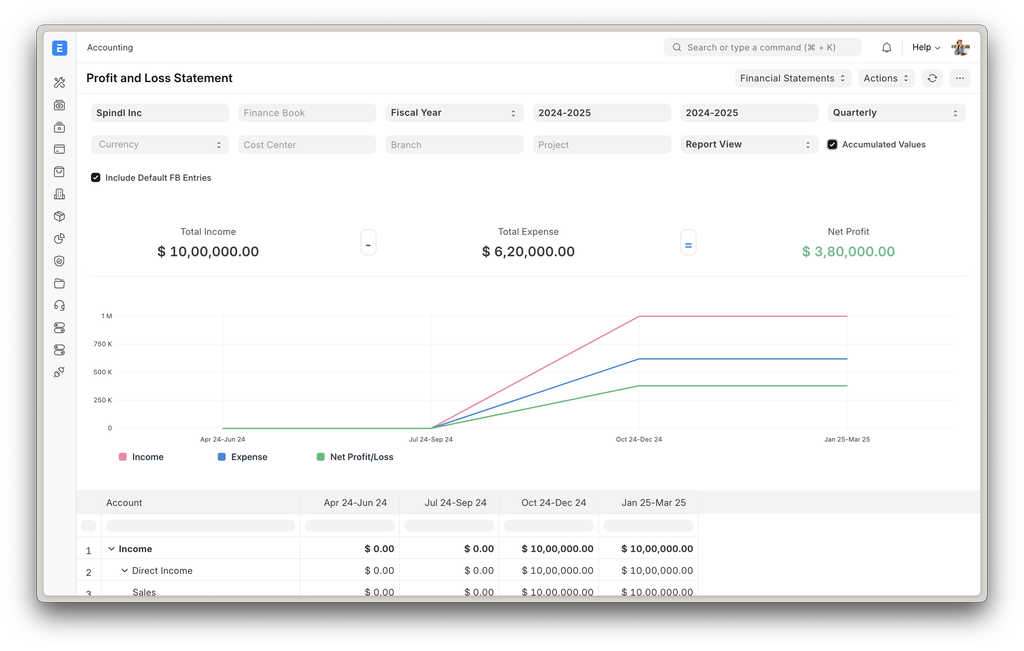
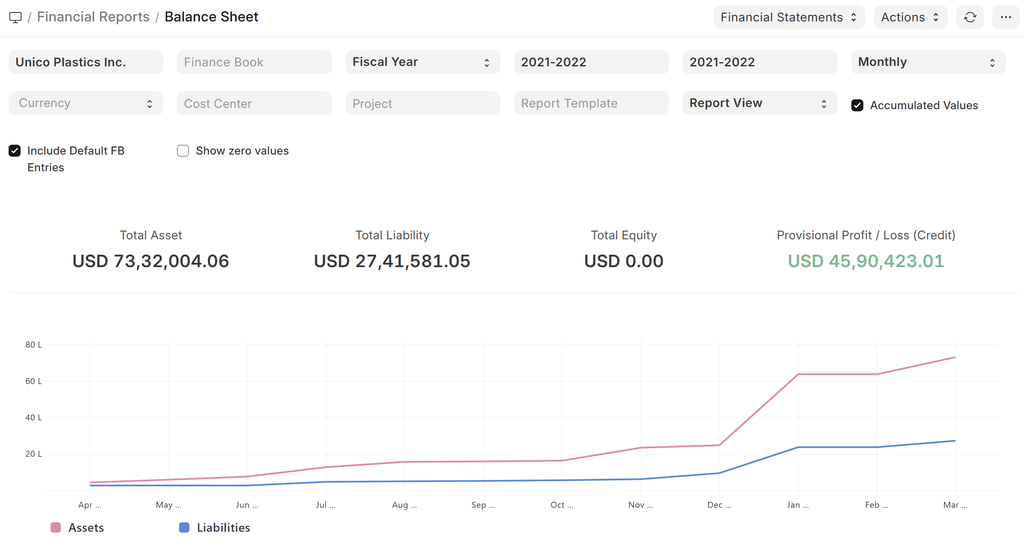
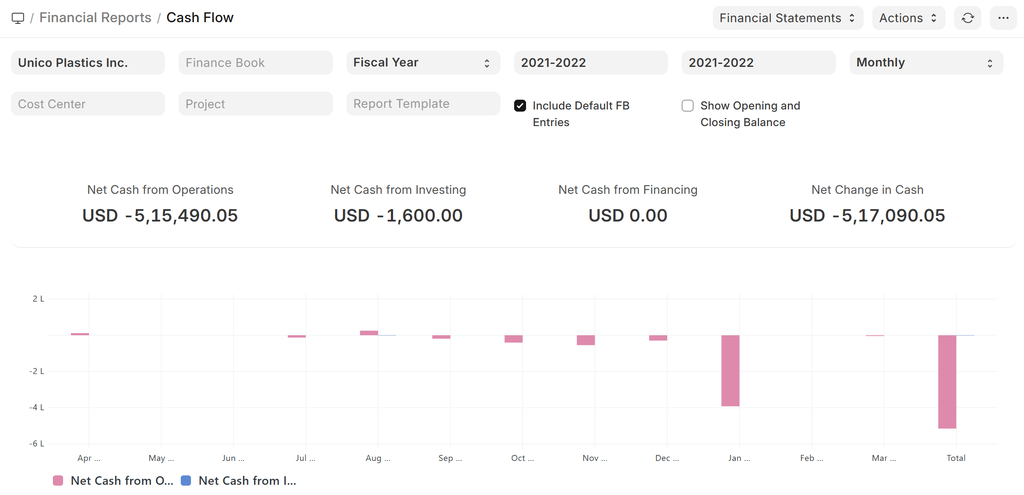
Real-time financial reporting. Board-level statements generated in seconds, not days.
Your data. Your jurisdiction.
Enterprise-grade infrastructure with deployment options that meet regional data sovereignty requirements.
Data Residency
Deploy in Egypt, UAE, KSA, or any region. Your financial data stays in the jurisdiction you choose. Sovereignty by design.
Encryption
TLS 1.3 in transit. AES-256 at rest. Role-based access with session management. Every connection secured.
Deployment Options
Prospera Cloud (managed). Private cloud (AWS, Azure, GCP). On-premise. Choose what your compliance requires.
Backup & Recovery
Automated daily backups. Point-in-time recovery. Disaster recovery with configurable RPO/RTO. Your ledger is never at risk.
Audit & Compliance
Full audit trail on every record. GDPR-aware data handling. Segregation of duties. Ready for external audit from day one.
Uptime & SLA
99.9% uptime SLA on managed cloud. 24/7 monitoring. Incident response. Your finance never goes offline.
Platform Disclosure
Prospera ERP is built on the Frappe Framework and is a fork of ERPNext, the world's most deployed open-source ERP. We extend, customize, and integrate the platform with proprietary modules — including Prospera Expense, Prospera Sign, and CRM integration — to deliver a unified business operating system tailored for the Middle East and growing enterprises worldwide.
Everything the deck didn't cover.
The questions every CFO, CIO, and controller asks before they sign. Answered without the corporate dance.
You're built on ERPNext. How is that different from just deploying ERPNext?
ERPNext is the engine. Prospera is the vehicle built on top of it. We extend and customize the platform with proprietary modules (Prospera Expense, Prospera Sign, CRM integration via CloudOffix), a regional tax layer (Egypt/UAE/KSA/GCC), an opinionated chart-of-accounts library, and an implementation methodology refined across 9+ entities. You get the maturity and flexibility of the world's most deployed open-source ERP — delivered as a finished product, not a DIY project.
Does Prospera support direct bank feeds (like Plaid or real-time API sync)?
Honest answer: Out-of-the-box, no. Most banks — especially in MENA — don't expose open APIs for third-party ingestion. What we do natively:
- Import statements via MT940, CSV, Excel, or XML (the formats banks actually provide)
- Auto-match transactions against ledger entries in seconds
- Create missing vouchers directly from the reconciliation screen
Where a bank does offer an API (some international banks, or via aggregators like Plaid/Yodlee in supported regions), we can build a direct connector as a custom enterprise engagement. Prospera's open REST API makes this buildable in days, not months.
What does deployment actually cost? We've been burned before.
Fair question. Implementation cost is driven by three factors: scope (which modules), complexity (how many entities/currencies/tax regions), and data migration (how much historical data to carry over).
Fast-track rollouts (standard COA, single entity): 4–6 weeks, predictable fixed fee. Multi-entity groups with custom workflows: 8–12 weeks, phased. Annual platform cost is a fraction of NetSuite/SAP — typically 60–80% less over five years. See our pricing anchor for transparent ranges.
Open-source base — isn't that a security or support risk?
The opposite. The Frappe/ERPNext core is audited by thousands of deployments globally. Security patches ship faster than closed-source vendors. And your data lives on infrastructure you control — not in a vendor's walled garden.
Support: we offer enterprise SLAs with 24/7 monitoring, defined response times, and a named technical account manager on higher tiers. You get the transparency of open source with the accountability of a commercial partner.
Will my data stay in my jurisdiction? (Egypt, UAE, KSA data sovereignty)
Yes. You choose the deployment model: Prospera Cloud (managed in your region), private cloud (your AWS/Azure/GCP account), or on-premise. We have active deployments in Egypt and across the GCC. Compliance-driven industries (healthcare, finance, government-adjacent) typically choose private cloud or on-premise.
How does Prospera handle multi-entity, multi-currency consolidation?
Natively. One chart of accounts (or multiple harmonized COAs), entity-level books with automatic elimination entries, daily FX revaluation across 190+ currencies, and real-time consolidated financials. NSAS Travel Group runs 9 entities on a single Prospera instance. No middleware. No monthly scramble.
Can we migrate from QuickBooks, Xero, NetSuite, or SAP?
Yes — migration is part of every implementation. Our typical approach: historical data (up to 3 years) imported as read-only reference, opening balances reconciled at cutover, go-live on Prospera with parallel running for 1 month. QuickBooks/Xero migrations are fast (2–3 weeks). NetSuite/SAP migrations are slower (6–10 weeks) because the data models are deeper. We've done all of these.
What happens if we outgrow Prospera, or want to switch later?
Your data is portable. Full database exports, documented schema, open API for continuous replication, standard accounting files (CSV, IIF, MT940). Unlike NetSuite (which actively makes exits painful), we believe customer freedom is a feature. If you ever leave — and some do, after being acquired by a SAP-standard parent — we'll help you get out cleanly.
Who supports us after go-live?
Prospera Systems (that's us) owns post-implementation support directly. Response time is defined in your SLA. Higher tiers include a named Technical Account Manager, quarterly reviews, and priority roadmap input. You don't hand off to a reseller — we built it, we support it.
Still have questions? Email Tarek directly → or book a 30-min call.
Run finance.
Without the chaos.
See Prospera Accounting in 30 minutes. One architecture for every ledger, every entity, every dollar.